

Decoding sweater symbolism
The history behind the hand-knit Lillehammer sweater
In honor of the frigid weather this week, I’m reposting an updated version of my original blog post about the Norwegian Lillehammer sweater.
My grandmother was a fantastic knitter and total perfectionist. I remember her ripping out rows and rows to fix the tension of a single stitch. For her it was all about the challenge — figuring out how to make something new and different.
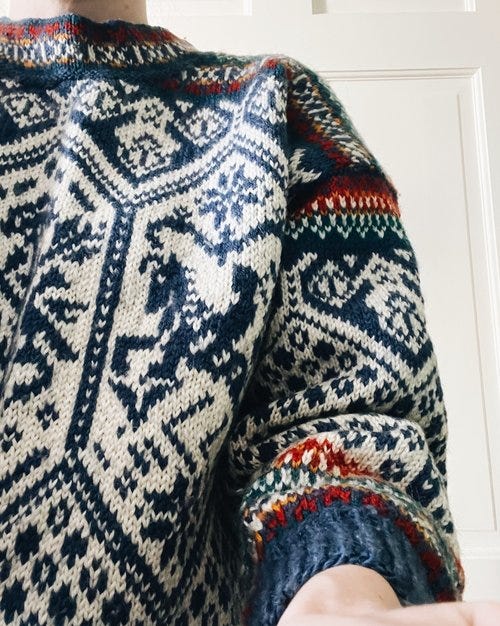
This was one of her later sweaters and a lifetime of honing her craft shines in all of the tiny details. Look at these cast on edges and seams! I could never imagine getting stitches this clean.
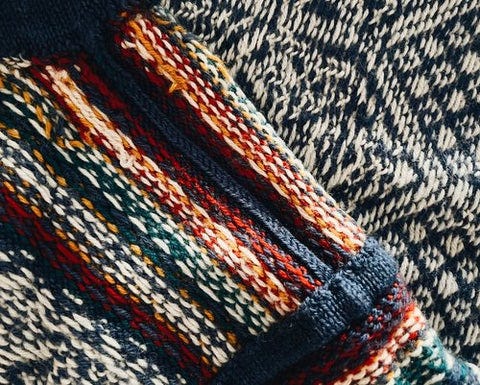
I started searching for info about color work techniques and patterns and found a fascinating YouTube series about the history of Norwegian knitting design from Arne & Carlos.
As with most needlework, all of the images are symbolic of cultural traditions or shifts; the materials are reflective of socioeconomic status and local tradition; and the design is based on the eventual use or environmental needs.
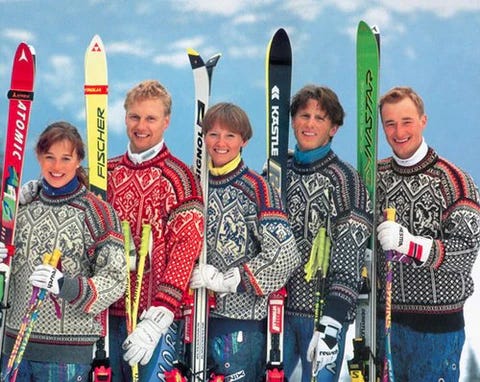
This particular sweater was developed as the official sweater for the 1994 Lillehammer Olympics. It is highly reflective of traditional Norwegian knitting. It’s the type of pattern that would have served many purposes in a historical Norwegian household.
Practicality: super warm for frigid climates
Stranded knitting (like this sweater) was developed as a defense against frigid weather. By floating the yarns, you end up with added insulation. There are actually two layers of wool — the top layer that you see, and the bottom layer of these floats that are skipping around the back until it’s their time to come back to the front.
Identity: a political statement
The knitting tradition in Norway dates back to the 8th century, before the Vikings, though the decorative patterns became widespread in the 19th century. After Norway gained independence from Denmark, people sought to create a distinct identity, and knitting became an art form and a political statement.
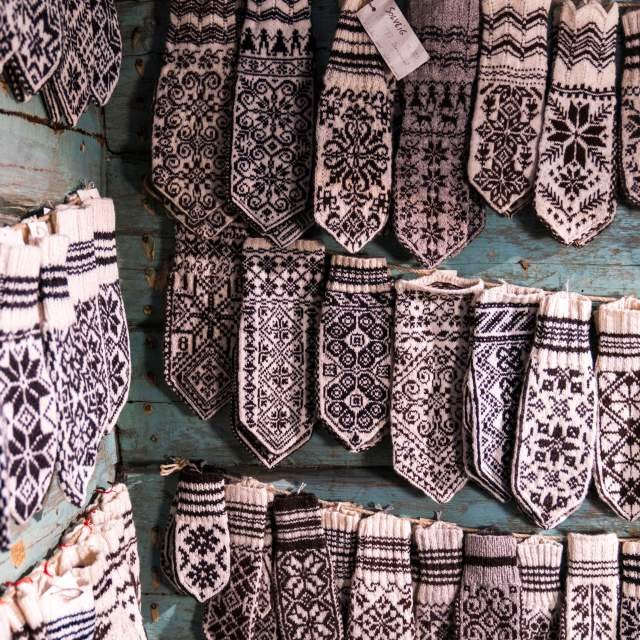
This sweater is most similar to the ancient lusekofte (“lice jacket”) from the Setesdal region. It features the iconic, eight-pointed star (Selbu rose), a defining symbol of Norwegian knitting after a young woman wore black and white mittens featuring this pattern to church in 1814. Today, women still honor this folk tradition by knitting intricate mittens with the Selbu rose as wedding gifts for men.
Protection: clothing as a spiritual tool
Norwegians in the 19th century were deeply religious and superstitious people. They (literally) knit protections into their fabrics with symbols and colors. The brilliant knit designer Eli Leistad lays out the historical meaning of color on the KDD blog.
Black was the color of sorrow and witchcraft. It was meant to protect against danger and darkness.
White symbolized purity and holiness. It offered the wearer healing protections, luck, and love.
Red represented fire, blood, and struggle. It represented the blood, love, and sacrifice of Christ.
I’m now inspired to cast on a new sweater project. Or just go back through my closet and interpret the symbolism of all my vintage hand knit pieces :)
If you want to make it yourself, here is the full PDF of the sweater pattern, as well as patterns for the mittens, hat, and socks! You could knit an entire Norwegian set :) A few brave souls have knit this pattern over the years, which you can see over on Ravelry.
Pattern: Dalegarn 1994 Lillehammer
This was also apparently sold as a machine-knit sweater — I’m assuming as Olympic village merch? I found a few in Etsy vintage stores for $150-275.
the 1994 Olympics team photo is so adorable! Great post x